


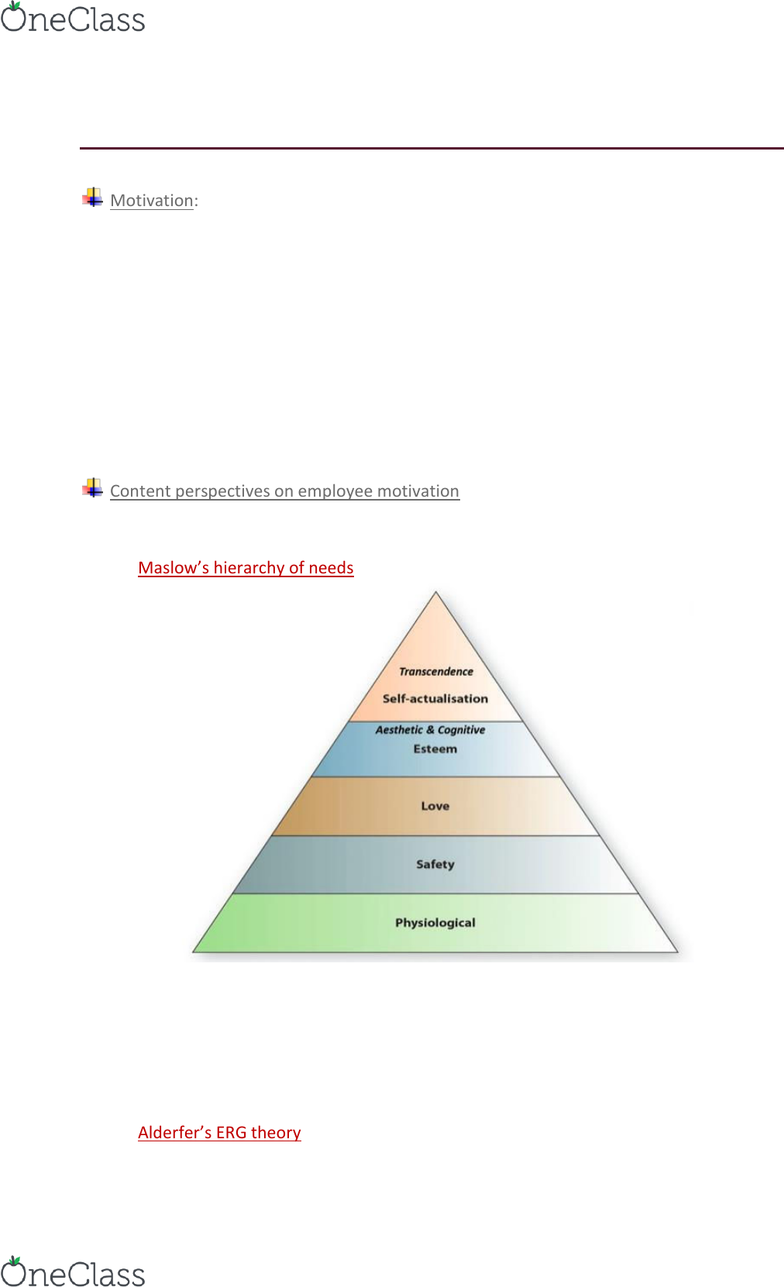
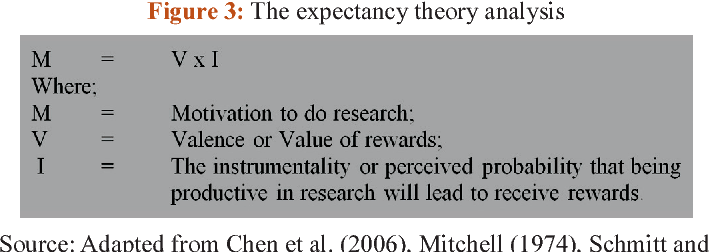
Contrasting Maslow’s Theory of Needs with Vroom’s Expectancy Theory. As suggested by Victor Vroom and unlike Maslow’ theory, the expectancy theory of motivation does not focus on needs but concentrates in the results. When Maslow’s hierarchy of needs theory concentrates on the association of internal needs of an individual and the expected effort needed to satisfy them such as time and money, Vroom puts apart effort (a result of motivation), performance, and results/outcome. Expectancy Theory. One of the most widely accepted theories of employee motivation was developed by Victor Vroom in 1964. Expectancy theory is based on the premise that a person will be motivated to put forth a higher level of effort if they believe their efforts will result in higher performance and thus better rewards. If we break down this. The Maslow motivation theory is one of the best known and most influential theories on workplace motivation. Psychologist Abraham Maslow first developed his famous theory of individual development and motivation in the 1940’s. He suggested that human beings have a hierarchy of needs. That is, that all humans act in a way which will address. Criticism of Vroom’s Expectancy theory 1) Edward Lawler claims that the simplicity of expectancy theory is deceptive because it assumes that if an employer makes a reward, employees will increase productivity to obtain the reward. However, this is only possible when if the employee thinks that it is beneficial to their immediate needs.
Core of equity is the principle of balance or equity. According to this theory of motivation, an individual’s motivation level is connected with his perception of equity, fairness and justice practiced by management. Equity can be measured by comparing the cost and the reward for each person. This theory was first developed in the year 1960 by J. Stacy Adams. J. Stacy Adam was a workplace and behavioral psychologist, who affirmed that employees seek to maintain balance between the inputs they bring to a job and the outcomes that receive from the job. It is believed that people value fairness and to keep them motivated, fairness is maintained between the co-workers and the organization. Adams suggested that higher the fairness perceived by an employee, higher will be the motivation and vice versa. Common way to see the equity theory at work is when the employee compares the work they do with someone else who gets paid more than them.
This is a comparison between two worker’s A and B. If the output-input of worker A is greater than B, then it is over rewarded, which leads to no motivation. Because he will start thinking that he is getting more money so his efforts towards the job will decrease. When the output-input level of worker A is less than the worker B, it is a situation of Negative Tension State, in which an employee will get motivated to work. Equity is achieved when the output-input relationship of both the workers remains same.
Referents: These are the four comparisons an employee can make.
Self-inside: An employee’s experience in a different position inside his present organization.
Self-outside: An employee’s experience in a situation outside the present organization.
Victor Vroom Expectancy Theory 1964
Other-inside: Another employee or group of employees inside the employee’s present organization.
Other-outside: Another employee or employees outside the employee’s present organization.
Inputs:
- Time
- Education
- Experience
- Effort
- Loyalty
- Hard work
- Ability
- Adaptability
- Tolerance
- Determination
Outputs:
- Job Security
- Job Safety
- Recognition
- Reputation
- Responsibility
- Praise
- Employee Benefits
- Sense of achievement

Assumptions of Equity Theory
- This theory indicates that an individual is concerned with what he is getting and also what others are getting in their comparison.
- Employees expect fair and equitable return from their jobs.
- Employees themselves decide what is equitable and fair for them, after comparing them with the other employees.
- Employees who feels that they are being in an inequitable scenario, they will try to distort the input or the output of the company or by quitting the organization.
Importance of the equity theory of motivation

Criticism Of Vroom 27s Expectancy Theory Of Motivation Interviewing
a) Achievement- Through this theory, an employee will feel equitable and fair. So, his motivation will be increased and since the motivation will increase, employee will start working towards his goal more to achieve the target before time and get equally rewarded for it.
b) Diversity- Diversity is the result of workplaces functioning equitably. Diversity means more experience, more perspective and more source material to draw from in brainstorming.
Criticism of the equity theory of motivation
- Since every organization has some structure, so it is not easy for the managers to have equity in the whole organization.
- If managers will keep workplace equity, then it means that there will be no distinction among employees and everything will be same. Since, every employee gets motivation on the basis of salary and other factors and if they remove all these from the organization, motivation among the employees will be removed.
- Financial Solvency- An organization without clearly defined roles means all employees should be equally compensated. In a workplace with total equity, there is no delineation between roles and therefore no distinction that separates management roles from support roles. The result is that all employees would be classified as equal and paid as such, regardless of an employee's actual job function.
Criticism Of Vroom 27s Expectancy Theory Of Motivation Psychology
Few important topics related Employee motivation
Expectancy Theory Of Motivation Definition
- Motivation Theories
- Methods of motivating employees
- The Needs Theory
- ERG Theory of Motivation
- Acquired Needs Theory
- The Equity theory of Motivation
- Vroom’s Expectancy Theory
- Thorndike's Reinforcement Theory
- Locke’s Goal Setting Theory
- Self Determination
- Cognitive Evaluation Theory
- Reward Systems & Employee Behavior